How Nebraska Weather Destroys Your Business Sign
UV radiation, hail, wind, ice, and temperature extremes — the Great Plains deliver every type of weather punishment to exterior signs. Here is what is happening to yours, and what you can do about it.
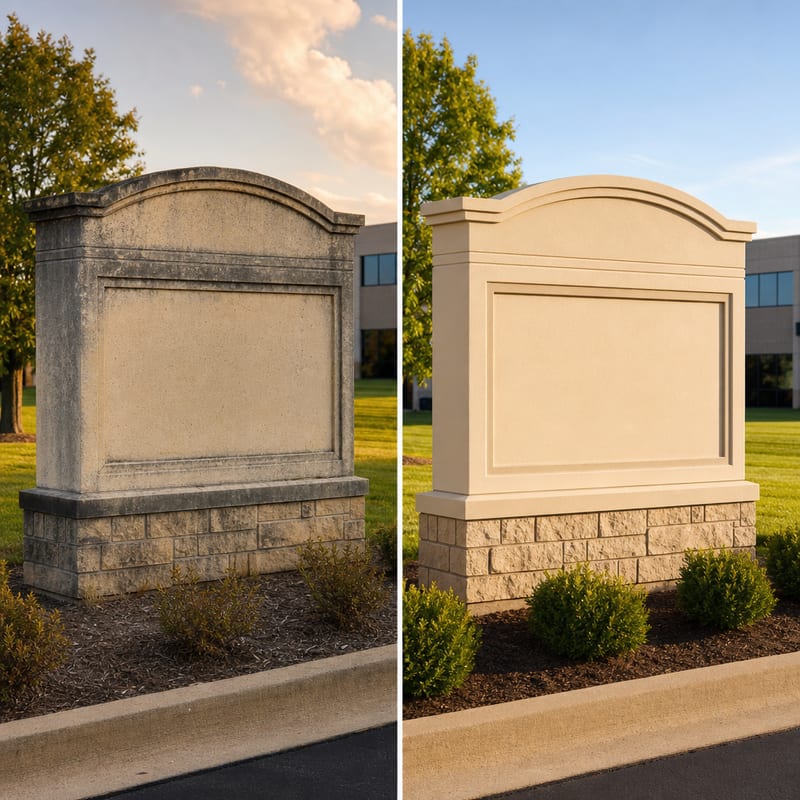
Your Sign Is Under Attack Every Single Day
Eastern Nebraska sits at the crossroads of some of the most punishing weather in North America: blistering summer sun, violent spring thunderstorms with large hail, howling winter winds that drive wind chills to minus forty, and temperature swings of fifty degrees in a single day. Every one of these weather events is slowly — or sometimes suddenly — destroying your exterior business sign.
Most sign owners do not notice the damage until it becomes visually obvious: a cracked face, a dark band where a fluorescent tube has burned out, paint that is visibly peeling and flaking. But the degradation begins the day the sign is installed and accelerates with every passing season. Understanding how Nebraska weather attacks your sign is the first step toward protecting it — and toward making informed decisions about restoration versus replacement when the damage becomes undeniable.
Five Ways Nebraska Weather Attacks Your Sign
UV Radiation & Sun Fading
Nebraska receives an average of 215 sunny days per year, and the summer sun at this latitude delivers intense ultraviolet radiation that breaks down the molecular bonds in paint pigments, vinyl graphics, and plastic sign faces. Acrylic and polycarbonate sign faces yellow and become brittle. Vinyl graphics crack, curl, and lose color fidelity. Paint chalks, fades, and eventually powders away. South- and west-facing sign faces deteriorate fastest because they receive the most direct afternoon sun exposure. A sign that was vibrant and sharp when installed can look washed out and tired within just five to seven years of Nebraska sun exposure without any protective maintenance.
Hail Impact Damage
Nebraska sits in the heart of Tornado Alley and Hail Alley, and the Omaha and Lincoln metros experience significant hail events multiple times per year. Hailstones ranging from pea-sized to golf ball-sized and larger strike sign faces with tremendous force, creating pinpoint cracks, star fractures, and outright punctures in acrylic and polycarbonate panels. Even small hail can micro-fracture the surface of a polycarbonate face, creating a network of tiny cracks that dramatically accelerate yellowing and fogging. Large hail can punch clean through a sign face or shatter it entirely. After every significant hail storm in the metro, we receive calls from sign owners who never had a problem before the storm — and suddenly have a face full of cracks, dents, or holes.
Wind & Structural Stress
Eastern Nebraska regularly experiences sustained winds of 30 to 50 mph with gusts exceeding 70 mph, particularly during spring storm fronts and winter blizzards. These wind loads stress every connection point on a sign: the face retainer systems, the cabinet seams, the mounting hardware, the structural welds, and the anchor bolts. Over years of cyclic wind loading, retainer clips loosen, seams separate, and mounting hardware fatigues. Double-faced signs can develop a rattle or visible vibration in high winds, which is a sign — pun intended — that structural connections are failing. Pylon signs are especially vulnerable because their height catches higher-velocity wind, and any looseness in the face system allows wind to infiltrate the cabinet, potentially tearing faces off entirely in extreme events.
Ice, Snow & Freeze-Thaw Cycling
Winter in Nebraska means repeated freeze-thaw cycles that are devastating to sign materials. Moisture infiltrates seams, cracks, and joints during the day, then freezes and expands at night, prying joints apart and widening cracks with every cycle. Ice loading on sign faces can bow or fracture acrylic and polycarbonate panels. Snow accumulation on top of monument signs and cabinet signs adds weight and moisture that accelerates corrosion of metal components and deterioration of masonry bases. Road salt splash from adjacent streets and parking lots corrodes metal sign bases, cabinets, and mounting hardware at an alarming rate. By late winter, many monument signs along major arterials in Omaha and Lincoln show visible salt staining and corrosion at the base line.
Temperature Extremes & Thermal Cycling
Nebraska temperatures range from minus twenty degrees in January to over one hundred degrees in July — a swing of 120 degrees across the year, and it is not uncommon for a single spring day to see a forty-degree temperature change between morning and afternoon. Every material in your sign expands when heated and contracts when cooled, and different materials expand at different rates. This differential thermal expansion stresses every joint, seam, fastener, and adhesive bond in the sign system year after year. Over time, seams separate, adhesive bonds fail, caulked joints crack, and fasteners loosen — all creating pathways for water intrusion that accelerate every other form of deterioration.
Fluorescent & Neon Failure in Cold
Older fluorescent and neon-illuminated signs have a specific Nebraska vulnerability: cold-weather performance failure. Fluorescent tubes, particularly T12HO lamps commonly used in sign cabinets, struggle to start at temperatures below about twenty degrees and produce significantly reduced light output as ambient temperature drops. Neon tubing similarly dims in extreme cold. During Nebraska winter cold snaps, fluorescent-illuminated signs across the metro visibly flicker, dim, or fail to start at all — sometimes for days at a time. This is not just an aesthetic problem; it means your business is invisible to potential customers during the darkest, most visibility-dependent time of year. LED retrofits eliminate this problem entirely, as LEDs perform at full brightness in any temperature.
Protecting & Restoring Your Sign Against Nebraska Weather
Regular Professional Cleaning
Annual professional sign cleaning removes corrosive road salt, pollution film, bird droppings, and biological growth before they can cause permanent damage. A clean sign also lets you spot developing problems early, when they are still inexpensive to fix.
Proactive Maintenance
Do not wait for a tube to burn out or a face to crack. Proactive maintenance — re-caulking seams, tightening retainers, replacing aging ballasts before they fail — prevents the small problems that lead to big, expensive ones.
LED Retrofit
If your sign still uses fluorescent or neon illumination, an LED retrofit is the single most impactful weather-resilience upgrade you can make. No more cold-weather failure, no more burned-out tubes, no more ballast replacements — just reliable, brilliant light year-round.
Full Restoration When Needed
When weather damage has progressed to the point of cracked faces, peeling paint, or structural deterioration, a full restoration — face replacement, repainting, lighting upgrade, and structural repair — brings the sign back to like-new condition for a fraction of replacement cost.